Sun’s Hidden Shape Revealed by Simple Shadow Trick
A simple shadow illusion reveals the Sun's true shape, demonstrating the pinhole camera effect. This everyday phenomenon confirms the Sun is round, regardless of the aperture's shape, by projecting a perfect circle of light.


Sun’s Roundness Confirmed by Everyday Pinhole Effect
A simple observation, easily replicated with common household items, offers a profound confirmation of one of astronomy’s most fundamental truths: the Sun is round. This phenomenon, often witnessed as dappled light under trees, demonstrates the principles of a pinhole camera and reveals how the shape of the light source, not the aperture, dictates the projected image.
The Pinhole Principle Explained
Imagine holding a piece of cardboard with a small hole in it. When you hold this cardboard up to a light source, like the Sun, and observe the light passing through the hole onto a surface behind it, you’ll notice a distinct shape. If you were to slowly lift the cardboard away from the surface, the projected shape would appear to blur and then morph into a perfect circle, regardless of the shape of the hole itself.
This curious effect can be tested with various apertures. Whether the hole is square, triangular, star-shaped, or even an irregular V-shape, the resulting projection of the Sun is consistently a circle. The key to understanding this illusion lies not in the shape of the aperture, but in the nature of the light source itself.
The Sun as the Ultimate Light Source
The reason behind this universal circular projection is that the Sun, from our perspective on Earth, is a spherical object. When the cardboard is positioned at a sufficient distance from the projection surface, it acts as a rudimentary pinhole camera. In this setup, you are no longer observing the hole in the cardboard directly. Instead, you are witnessing a projection of the light source itself.
A pinhole camera works by allowing light rays to pass through a tiny opening. Crucially, these rays travel in straight lines. Rays from the top of the Sun will pass through the pinhole and form the bottom of the projected image, while rays from the bottom of the Sun will form the top. Similarly, rays from the left form the right of the image, and rays from the right form the left. This inversion, combined with the fact that the Sun is a sphere, means that the projected image will always be a circle, mirroring the Sun’s true shape.
Nature’s Own Pinhole Cameras
This principle is not just confined to controlled experiments with cardboard. It is a phenomenon that occurs naturally, most notably in the dappled light seen beneath trees on a sunny day. The leaves and branches of the tree create numerous small, irregular gaps. As sunlight filters through these gaps, each one acts as a tiny pinhole. The collective effect of these countless pinholes projecting the image of the Sun results in the beautiful, circular patterns of light often observed on sidewalks and forest floors.
This natural display is a constant, albeit often overlooked, reminder of the Sun’s spherical form. The thousands of tiny, bright circles are not random shapes; they are miniature images of our Sun, projected through the natural apertures provided by the foliage.
Historical Context and Scientific Significance
The understanding of light traveling in straight lines and forming inverted images through small apertures dates back to ancient times. Philosophers and scientists, including Aristotle and Alhazen (Ibn al-Haytham), observed and documented the principles of the camera obscura, the precursor to modern cameras. Alhazen, in particular, conducted extensive experiments in the 10th century, laying down the foundations for optics.
The realization that the Sun is a celestial body, and not a divine entity, was a monumental shift in human understanding, a process that unfolded over centuries. Early astronomers like Copernicus, Kepler, and Galileo revolutionized our view of the cosmos, establishing the heliocentric model. While these figures provided the grander cosmological framework, the simple pinhole effect offers an intuitive, everyday demonstration of a key characteristic of our nearest star: its roundness. It’s a tangible link to the scientific understanding that the Sun is a massive, spherical ball of plasma, approximately 1.39 million kilometers (864,000 miles) in diameter, fueling our solar system with its energy.
What Comes Next?
While the pinhole effect is a simple demonstration of the Sun’s shape, our exploration of the Sun is far from over. Missions like NASA’s Parker Solar Probe, launched in 2018, are currently venturing closer to the Sun than any previous spacecraft, aiming to unravel mysteries about solar wind and the Sun’s atmosphere. By studying the Sun up close, scientists hope to better understand space weather, which can impact satellites, power grids, and even astronauts in space.
Future missions will continue to observe the Sun, providing more detailed data on its activity, magnetic fields, and evolution. Understanding our Sun is crucial not only for comprehending our solar system but also for appreciating the conditions necessary for life on Earth. The humble shadow play, however, serves as a timeless and accessible reminder of the fundamental nature of the star that sustains us.
Source: The Shadow Illusion (YouTube)

Related Articles


NASA Pivots: Mars Nuclear Probe, Moon Base Ahead
NASA is pivoting its exploration strategy, prioritizing a nuclear-powered Mars probe and accelerating plans for a moon base. The International Space Station's future is uncertain, with a shift towards commercial platforms. Meanwhile, new telescope data reveals overmassive black holes in dwarf galaxies and captures stunning images of Saturn and the Crab Nebula.


Dark Matter Defies Gravity, Forming Fuzzy Clouds Instead of Stars
Dark matter, which outweighs all visible matter, surprisingly does not collapse under gravity to form stars or black holes. Instead, it forms vast, diffuse clouds around galaxies, baffling scientists with its unique behavior. Understanding this cosmic enigma is key to comprehending the universe's structure and evolution.

New Satellites Capture ‘Impossible’ Colors from Space
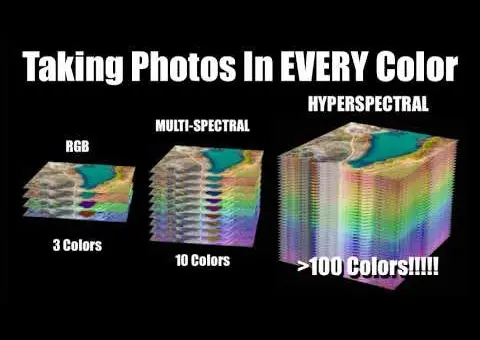
New hyperspectral satellites are capturing images with hundreds of color bands, revealing details invisible to the human eye and traditional cameras. This advanced technology builds on a 200-year legacy of spectral analysis, enabling unprecedented insights into Earth's resources and environment.