Xi’s Marriage Plan Echoes CCP’s Dark Past
China's new policy to arrange marriages for unmarried soldiers echoes a dark chapter of population engineering from the 1950s. The initiative, framed as supporting military morale, raises concerns about women being used as political tools, mirroring historical coercion and exploitation.

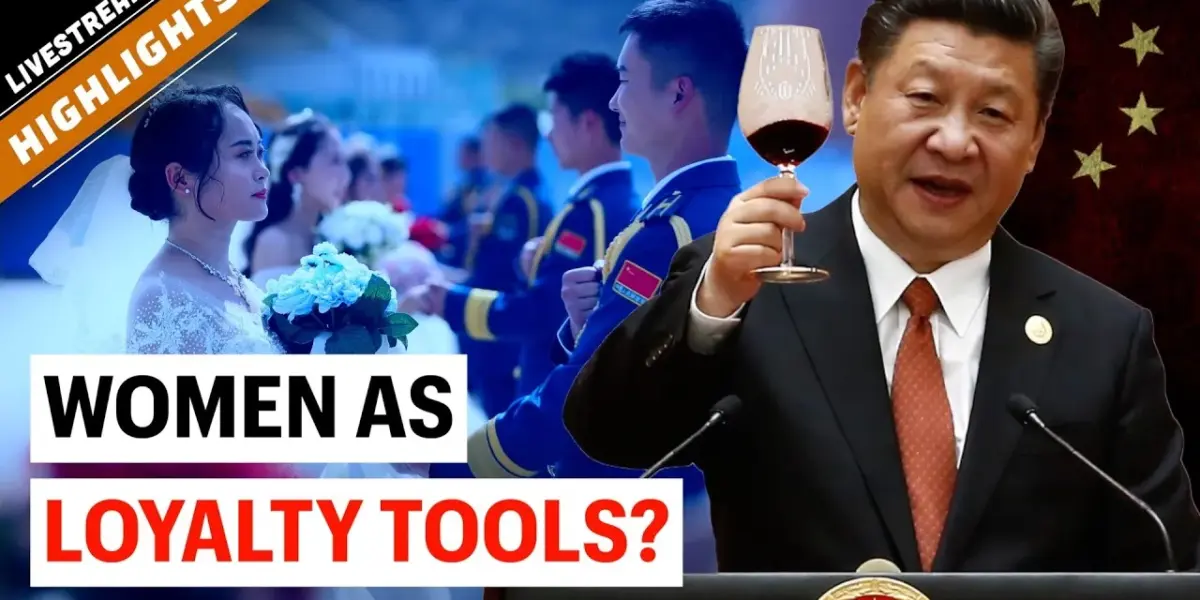
Xi’s Military Marriage Plan Echoes CCP’s Dark Past
In a move that has raised eyebrows and drawn historical parallels, six disparate Chinese organizations, ranging from military institutions to civilian federations, have jointly issued a policy document aimed at improving marriage and relationship services for older, unmarried military personnel stationed in remote and harsh regions. The document, prominently featured by the PLA Daily, is framed as a practical measure to implement President Xi Jinping’s doctrine of “warming the hearts of soldiers” by providing matchmaking, counseling, and family support to help them focus on military strengthening. However, beneath the surface of this ostensibly benevolent initiative lies a chilling echo of a controversial population engineering policy enacted by the Chinese Communist Party (CCP) approximately 75 years ago.
A Historical Precedent: Population Engineering in Xinjiang
The current policy’s logic bears a striking resemblance to a campaign initiated shortly after the CCP’s rise to power in 1949. At that time, the northwestern frontier region of Xinjiang presented a unique challenge: a large contingent of soldiers, many of whom were single men. General Wang Jun, a founding marshal of the PLA, was tasked with establishing order and control. The region was populated by approximately 100,000 defected Nationalist troops, predominantly middle-aged and with families elsewhere, alongside an additional 100,000 CCP troops. The vast majority of these soldiers were bachelors, creating a perceived problem of instability in the frontier.
In response, General Wang Jun launched a recruitment drive in Hunan province in the fall of 1950, seeking young women to bolster the population of Xinjiang. Advertisements depicted Xinjiang as a land of opportunity, promising education, work in factories, and agricultural roles. The requirements were simple: single women between 16 and 25 with at least a high school education. The recruitment focused on patriotism and the idea of dedicating youth to national development. Many young women, inspired by revolutionary slogans and the promise of adventure, responded enthusiastically. Some even resorted to deception, such as stuffing shoes for height or filling pockets with stones to meet physical requirements, to join the program.
Within a year, over 3,800 women from Hunan were recruited, followed by another 4,000 the next year. This became known as the “8,000 Hunan girls to the Tian Mountains” epic. However, the reality for these young women was far removed from the advertised opportunities. As their trains moved west, the focus of military leaders’ speeches shifted from revolution to romance, relationships, and marriage. Upon arrival in Xinjiang, they found themselves in a desolate, isolated environment with no escape. The promised factories, schools, and tractors were absent. They were assigned to farms populated almost entirely by men, with the number of women calculated based on the number of single officers.
Many of these women, some as young as 13, were coerced into marriages with men decades older than themselves. Archive records detail tragic outcomes, including instances of women driven to insanity or suicide. The recruitment efforts continued, expanding to include nurses from eastern China and, when those proved insufficient, widowed women from Shandong and even “re-educated” prostitutes from Shanghai. By 1954, with women constituting about 40% of the population in the military settlement system, the soldier marriage problem was largely resolved, but at a profound human cost, often described as one of the largest organized human trafficking operations in modern history.
The Logic of Control in Modern China
The question arises: why would Xi Jinping revive such a logic in an era of advanced technology? The current policy, while framed differently, appears to stem from a similar underlying principle of control and stability. Following extensive purges within the PLA leadership, Xi Jinping’s administration faces a challenge in maintaining loyalty among the rank and file. The marriage initiative can be interpreted as a political transaction, using women and family ties as a means to secure the soldiers’ allegiance.
The CCP’s authoritarian system views family as a powerful tool of control. A single soldier may be unpredictable, susceptible to outside influences, or prone to dissent. However, a soldier with a family becomes more tethered to the system, possessing something valuable to protect and less inclined to risk their established life. The mobilization of organizations like the Women’s Federation and the Communist Youth League suggests a state-orchestrated effort to find and allocate “strategic resources” – in this case, potential partners – to solidify the loyalty of soldiers, particularly those stationed in sensitive or remote areas.
From Xi’s perspective, if senior leadership cannot be fully trusted, ensuring the unwavering loyalty of the lower ranks by “nailing them to the land” through familial bonds becomes paramount. This policy is less about individual soldier happiness and more about addressing a perceived loyalty gap created by political instability and suspicion within the military apparatus.
Why This Matters: Implications for Women and Society
The historical precedent casts a long shadow over the current policy. The women sent to Xinjiang decades ago were often treated as allocated resources, subjected to hard labor, and faced difficult personal circumstances, including early widowhood and lifelong separation from their homes. The potential for a recurrence of such exploitation, even in a modern context, is a significant concern.
The implications for women are profound. The policy risks turning women into bargaining chips in a state-driven agenda, undermining their autonomy and personal choices. The success of such a policy hinges on the willingness of women to participate, a factor that has demonstrably shifted since the 1950s.
Future Outlook and Potential Challenges
While the CCP’s authoritarian mindset remains focused on control, the societal landscape of China has transformed dramatically. The practical realities and expectations of Chinese women today are vastly different from those of the 1950s. Increased access to education, economic opportunities, and evolving views on personal fulfillment make the prospect of relocating to remote regions for a life intertwined with military service less appealing.
Furthermore, broader demographic trends, including declining birth rates and a growing reluctance to have children, complicate the notion of building families for state purposes. The appeal of a life involving potential hardship, limited income, and a role as a “reproductive machine for the state” is likely to be minimal for many. While the authorities might find a small number of willing participants, large-scale voluntary participation appears improbable.
The CCP’s historical approach of treating individual happiness as secondary to state objectives continues to inform its policies. However, the effectiveness of such top-down social engineering in contemporary China, where individual aspirations and practical considerations weigh heavily, remains to be seen. The current marriage initiative, therefore, represents a critical juncture, testing the limits of state control against the evolving aspirations of its citizenry, and raising questions about whether history will indeed rhyme or diverge in this instance.
Source: Xi’s Military Marriage Plan Has a Dark CCP Precedent (YouTube)

Related Articles


Trump’s Pressure Forces China to Rethink Economic Future
China's latest economic blueprint, revealed at the "Two Sessions," signals a significant recalibration driven by internal challenges and external pressures, particularly from the U.S. under Trump. Facing a "crumbling" economy, Beijing is lowering growth targets and pivoting to "new quality productive forces" while grappling with massive debt and a potential overcapacity crisis.


Iran War: An ‘Israeli Expansionist Project,’ Activist Claims
An activist has described the ongoing conflict in Iran as an 'Israeli expansionist project,' facilitated by the U.S. Susan Tamasi highlighted the devastating humanitarian impact, including the destruction of civilian homes and the erosion of women's rights. She criticized external calls for regime change, arguing that military interventions have historically led to chaos and destruction, not liberation.

China’s Silent Strait: A 192-Hour Blackout Hints at Deeper Military Woes
An unprecedented 192-hour silence from the PLA over the Taiwan Strait sparked speculation. Was it a peace gesture, a hidden 'kill switch' activated during global conflicts, or a sign of deeper military vulnerabilities within China?