Greens Surge in Baden-Württemberg, Stunning Conservatives
The Green Party has achieved a significant victory in the German state of Baden-Württemberg, narrowly defeating Chancellor Merz's CDU and potentially installing Cem Özdemir, the first state premier of Turkish heritage. The election also saw the far-right AfD continue its rise.

Greens Secure Key German State in Electoral Upset
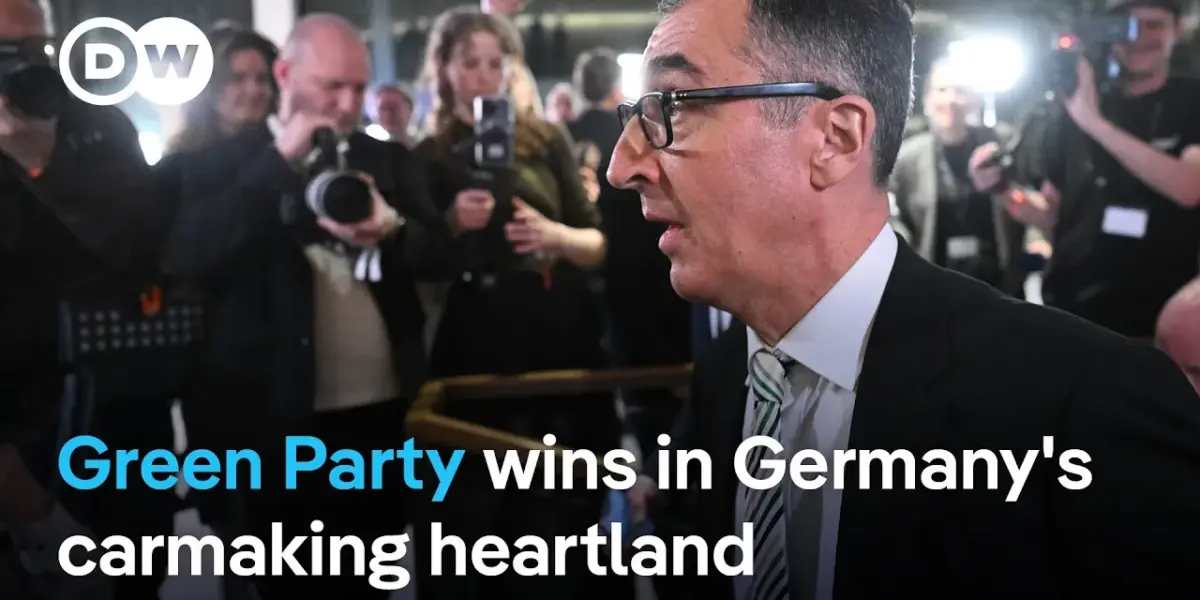
In a significant electoral development, the Green Party has emerged as the leading force in the crucial southwestern German state of Baden-Württemberg, projecting a win that defies expectations and deals a blow to Chancellor Friedrich Merz’s conservative Christian Democrats (CDU). The preliminary results, released from Stuttgart, indicate the Greens have secured 30.2% of the vote, narrowly ahead of the CDU’s 29.3%. This outcome, if confirmed, would allow the Greens to extend their hold on the state’s premiership for another five years and marks a historic moment, potentially ushering in Cem Özdemir as Germany’s first state premier with Turkish roots.
Historic Victory and a “Flexi-Green” Approach
The projected victory for the Green Party in Baden-Württemberg, a state renowned for its automotive industry, including giants like Mercedes-Benz and Porsche, represents a continuation of their political dominance in the region. Cem Özdemir, the Green Party’s candidate, is poised to become the next state premier, making history as the first German state leader with a background as a child of migrant workers. His parents emigrated from Turkey to Germany, adding a deeply personal and symbolic layer to this electoral success.
Speaking after the exit polls, Özdemir expressed a sense of cautious optimism, describing the situation as an “amazing comeback” but remaining somewhat reluctant to declare a full victory until final confirmation. “We have to wait a few more minutes until it’s finally clear that we’re number one,” he stated. “But one thing is clear – we will be part of the next government together with the Christian Democrats.”
Özdemir attributed the Green Party’s success to a “flexi-green” policy, emphasizing a pragmatic approach to governance. “We have coalitions here where we try to solve the problems behind curtains and then come with solutions. And that is the policy I would like to continue, unlike in Berlin,” he explained, drawing a contrast with the federal government’s dynamics.
Far-Right Continues Rise, Social Democrats Lag
While the Green Party celebrates its projected win, the election also highlighted the persistent rise of the far-right Alternative for Germany (AfD). The AfD secured third place with 18.8% of the vote, their largest share to date in Baden-Württemberg. This figure, though significant, fell short of the party’s own expectations, which had aimed for over 20%.
Michaela Kofner, DW’s Chief Political Editor, analyzing the results from Stuttgart, noted the AfD’s continued upward trajectory. “The far-right Alternative for Germany continues its path into the upper double digits and continues its rise also here in a key western state,” Kofner observed. “That is a victory although it is way behind their own expectations.”
The Social Democrats (SPD), a junior coalition partner in Chancellor Merz’s federal government, experienced a particularly difficult election. Kofner described their performance as being “battered” in Baden-Württemberg, a result that could have significant psychological repercussions at the federal level and potentially destabilize the national coalition.
Özdemir on Confronting the Far-Right
Addressing the AfD’s strong showing, Özdemir outlined his strategy for engaging with the party’s voter base while firmly rejecting their leadership. “I differentiate between the leaders of the AfD. I think the leaders of the AfD make very clear that they are following Mr. Putin, Mr. Orbán and there is no sense in trying to come together with them,” he stated. “They are in opposition to all the values of this country, to the constitution of this country.”
However, Özdemir emphasized his commitment to reaching out to AfD voters. “Having said that, I see my job, if I become the governor or the minister president of this state, in reaching out to their voter base and trying to win back as many people as possible for this country. Listen to them, talk to them, but of course also defend the values of our state.”
A Symbol of Opportunity and Inclusive Governance
The personal significance of Özdemir’s potential premiership was not lost on him. Reflecting on his background as the child of “guest workers,” he stated, “I haven’t forgotten where I come from. I come from a working-class family. I come from so-called guest workers. I’m the child of guest workers. So I see this also as an obligation to help every child to develop its full potential. So to prove that everybody can become whatever he or she wants to become. Let’s call this the ‘Baden-Württemberg victory.’ And I want to realize that.”
Broader Implications for German Politics
This election in Baden-Württemberg carries considerable weight beyond the state’s borders. It serves as a critical test for Chancellor Merz and the CDU, particularly as other state elections loom later this year. The projected surge in support for the AfD in this traditionally strong CDU territory raises concerns about the conservative party’s ability to counter the far-right’s appeal.
Furthermore, the potential instability for the federal coalition, stemming from the SPD’s poor performance, could complicate Merz’s governance. The “flexi-green” approach championed by Özdemir might offer a model for coalition building that prioritizes pragmatic problem-solving over ideological disputes, a strategy that could be observed in future political maneuvering.
Looking Ahead
As the final results are tallied, all eyes will be on the official confirmation of the Green Party’s victory and Cem Özdemir’s historic appointment. The performance of the AfD will continue to be a key indicator of the national political mood. For Chancellor Merz and the CDU, this election serves as a stark warning, demanding a re-evaluation of their strategies to regain voter trust and effectively address the challenges posed by the far-right and shifting political landscapes. The coming months will reveal whether the “Baden-Württemberg victory” is an isolated success or a harbinger of broader political realignments in Germany.
Source: Green comeback stuns Chancellor Merz's conservatives in key German state vote | DW News (YouTube)

Related Articles

Cem Özdemir’s Historic Rise: Germany’s First State Premier with Migrant Roots
Cem Özdemir, son of Turkish immigrants, is set to become Germany's first state premier with migrant roots. His historic rise reflects the nation's evolving identity and Özdemir's pragmatic approach to politics, balancing integration with policy implementation.

NATO Confirms Downing Second Iranian Missile Over Turkey
NATO confirmed it intercepted a second Iranian ballistic missile over Turkey, raising regional tensions. Turkey vows decisive action but seeks to avoid direct conflict with Iran, prioritizing diplomatic solutions amidst economic pressures.


Trump Eyes Iran Conflict for Global Oil Control
Political analyst Stanislav Bilovski suggests a potential U.S. military operation against Iran could be a strategic move by Donald Trump to control global oil markets and achieve domestic political goals. While Iran possesses regional resilience, its isolation and Russia's limited capacity to intervene paint a complex geopolitical picture. The outcome hinges on various factors, including the conflict's duration and potential U.S. domestic political maneuvers.