Allegations of a ‘$10 Billion Grift’ and ‘Shadow UN’ Spark Outcry Over Public Funds and Political Ethics
A recent report by Siri Crowe for the Midas Touch Network has unveiled explosive allegations of a '$10 billion grift' and a 'shadow UN,' accusing powerful political figures of widespread financial impropriety and misuse of taxpayer funds. From controversial international initiatives to alleged procurement schemes and lavish spending on luxury jets, the report paints a picture of systemic corruption and a profound disconnect between the political elite and struggling American citizens, prompting an urgent call for accountability and systemic change.

Allegations of a ‘$10 Billion Grift’ and ‘Shadow UN’ Spark Outcry Over Public Funds and Political Ethics
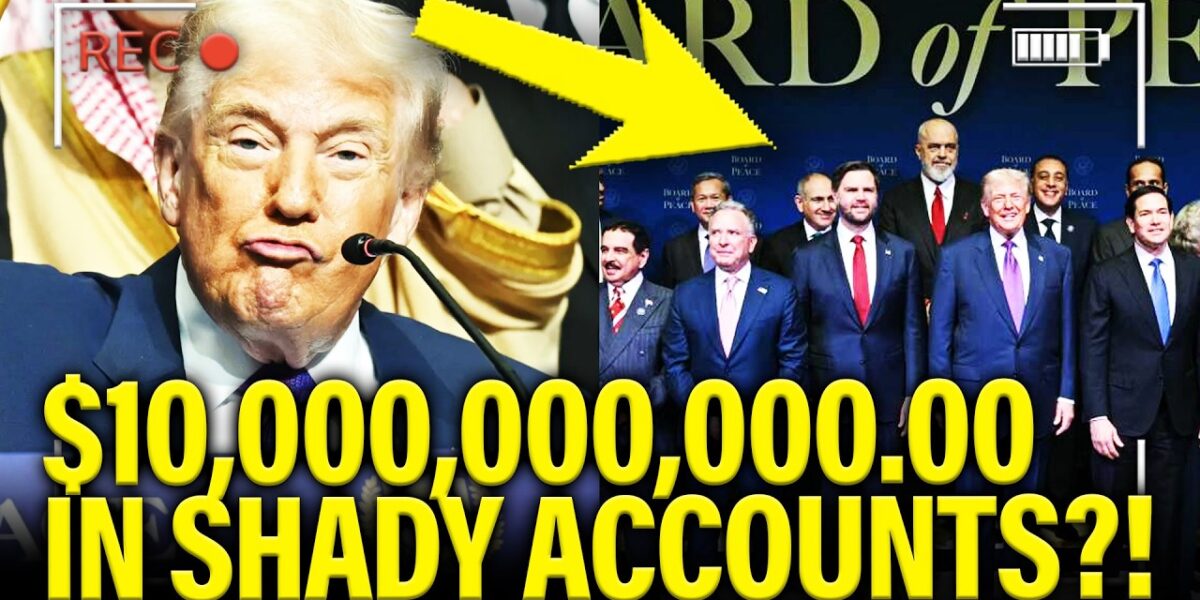
Washington D.C. finds itself embroiled in a fresh wave of controversy as a recent report from the Midas Touch Network, featuring commentator Siri Crowe, has ignited a fierce debate over alleged financial impropriety, misuse of taxpayer funds, and the potential emergence of a ‘shadow United Nations.’ At the heart of the storm are claims of a staggering $10 billion contribution to a nebulous entity dubbed the ‘Port of Peace,’ alongside accusations of widespread personal enrichment by high-ranking political figures and their associates, all at the expense of American taxpayers.
The allegations paint a grim picture of a political landscape where public service is allegedly intertwined with private gain, challenging the very foundations of accountability and trust in government. From a controversial international initiative to alleged procurement schemes and lavish spending, the report details a pattern of behavior that, if true, could represent a profound breach of public faith and a significant drain on national resources.
The ‘Port of Peace’: A ‘Criminal Enterprise’ or New World Order?
The most immediate and startling claim revolves around a proposed $10 billion contribution from the United States to an initiative referred to as the ‘Port of Peace.’ The transcript quotes a figure, attributed to former President Trump, stating, “the United States is going to make a contribution of $10 billion to the border of peace.” This figure is then downplayed as “a very small number when you look at that compared to the cost of war. That’s two weeks of fighting.”
However, Siri Crowe vehemently disputes this characterization, labeling the ‘Port of Peace’ as “by most estimates a criminal enterprise or the new access of evil.” Crowe alleges that this entity is a vehicle for former President Trump and other international figures – including Benjamin Netanyahu, Saudi Crown Prince Mohammed bin Salman (MBS), Vladimir Putin, and Viktor Orban – to “try to supplant the United Nations in a new world order.”
This accusation raises profound questions about the future of international diplomacy and the established global order. The United Nations, founded in the aftermath of World War II, serves as the primary forum for international cooperation, conflict resolution, and the promotion of human rights. An attempt to “supplant” such an institution with an alternative, particularly one allegedly comprising “corrupt autocrats” and “war criminals,” would represent a seismic shift in global governance, potentially undermining multilateralism and democratic norms worldwide.
The concept of a ‘shadow UN’ or an alternative axis of power is not entirely new in geopolitical discourse, often emerging during periods of perceived global instability or dissatisfaction with existing international bodies. However, the explicit accusation of it being a “criminal enterprise” directly linked to the alleged redirection of U.S. taxpayer funds injects a severe element of alleged corruption into the geopolitical discussion. Such a move, if it were to materialize, would likely face immense scrutiny from international bodies, human rights organizations, and democratic governments globally, potentially isolating the United States from its traditional allies and partners.
The claim that $10 billion is a “small number” compared to the cost of war is also met with sharp criticism in the transcript, with Crowe drawing a parallel to the former President’s business track record: “Oh, a very small number, is it? says the man who is bankrupting America as he has every single other business he’s ever run into the ground.” This comparison underscores a deep skepticism regarding the financial stewardship of public funds and a broader concern about the alleged monetization of political power.
Allegations of Personal Enrichment and Taxpayer Exploitation
Beyond the ‘Port of Peace’ controversy, the report delves into a series of other alleged financial abuses, painting a picture of systemic ‘grifting’ where public office is purportedly leveraged for personal gain. Crowe asserts that Trump is “just openly stealing $10 billion of our money from the US Treasury” and highlights an additional $10 billion lawsuit against the IRS, which is also characterized as a burden on taxpayers. These claims contribute to a narrative of the former President allegedly enriching himself and his associates during and after his time in office.
The Kushner Connection: Shady Dealings with the Saudis?
A significant focus of the allegations falls on Jared Kushner, former Senior Advisor to the President and son-in-law. Despite not being a White House official in his post-presidency role, Kushner is explicitly accused of “laundering money through his extremely shady business dealings with the Saudis.” This claim echoes long-standing concerns and media reports regarding Kushner’s financial activities following his tenure in the Trump administration. For instance, his private equity firm, Affinity Partners, received a substantial investment from Saudi Arabia’s Public Investment Fund (PIF) shortly after the Trump presidency concluded. This investment, reportedly approved despite objections from the PIF’s own advisory panel due to concerns about the “inexperience” of the firm, has drawn intense scrutiny.
The close relationship between the Trump administration and Saudi Arabia, particularly through Kushner’s involvement in Middle East policy, has been a subject of ethical debate for years. Critics have pointed to the potential for conflicts of interest, where diplomatic efforts and policy decisions might have been influenced by personal financial considerations. The transcript’s direct accusation of “money laundering” elevates these concerns to a criminal level, demanding rigorous investigation into the nature and transparency of these financial arrangements. The broader implications include questions about the integrity of U.S. foreign policy and the potential for private financial interests to dictate national strategy, especially concerning critical geopolitical regions like the Middle East.
Howard Lutnik and the DHS Detention Center Scheme
Another alleged scheme brought to light involves Howard Lutnik, CEO of Cantor Fitzgerald and BGC Partners, who is accused of having made his original billions through “Ponzi schemes.” The report alleges that Lutnik is now “pushing a scheme through the DHS, the Department of Homeland Security, by driving policies to buy these detention centers, aka concentration camps, at overvalued prices.” The mechanism described involves purchasing properties or warehouses “far over the property values that are then in turn making millions of dollars for his family business, which his son is now running.”
This accusation points to a severe form of alleged crony capitalism, where government contracts and policies are manipulated to benefit private entities, specifically at the expense of taxpayers. The Department of Homeland Security (DHS) oversees a vast network of immigration detention facilities, many of which are operated by private companies. The expansion and procurement of these facilities have long been subjects of controversy, particularly concerning conditions, human rights, and the profitability of private detention centers. If Lutnik’s alleged scheme is accurate, it would represent a direct exploitation of the immigration crisis for financial gain, using taxpayer money to inflate asset values and enrich connected individuals. This practice, often referred to as ‘price gouging’ or ‘wasteful spending,’ not only drains public coffers but also raises ethical alarms about the motivations behind government policy, particularly in sensitive areas like immigration enforcement.
Kristi Noem’s Luxury Jet: A Symbol of Disconnect?
The report then pivots to a more recent and illustrative example of alleged public funds misuse, focusing on South Dakota Governor Kristi Noem. Citing an NBC News report, the transcript details plans for “we the taxpayers, for we the peasants to foot the bill for a super luxury jet for her and her boyfriend Corey Lewandowski to fly around on.” The plane in question is a Boeing 737 Max 8, which DHS is reportedly awaiting White House approval to purchase for $70 million. The description of the jet’s interior—”a bedroom, multiple showers, large screen TVs, and a bar”—is contrasted sharply with its alleged purpose: deportations.
The transcript highlights the absurdity of this claim, questioning, “does this look like a jet that’s outfitted to fly ice detainees to you? Queen-size bed, cush seating, a bar, four large screen TVs. It can fly 18 and sleep 14 people. Most deportation flights carry 50 to 100 detainees and not very comfortably.” Two DHS officials are cited as calling the idea “far-fetched,” leading to the conclusion that “it’s a lie. It’s a complete lie. It’s a jet for her and her boyfriend Corey Lewandowski to do whatever it is they do at the U Mile High Club, if you will, and we’re paying for it.”
This incident, if the allegations hold true, serves as a potent symbol of the perceived disconnect between the political elite and ordinary citizens. At a time when many Americans struggle with rising costs and economic insecurity, the prospect of public officials acquiring lavish personal amenities under the guise of official duty can provoke widespread outrage. The fact that DHS already possesses a recently upgraded Gulfstream jet for the Secretary only adds to the perception of unnecessary expenditure and potential abuse of power. This alleged incident encapsulates the broader critique of government waste and the casual disregard for taxpayer money, reinforcing the narrative that public officials are living a life of luxury while the general populace faces increasing hardship.
The Broader Economic Landscape: ‘Welfare Queens’ and Crumbling Social Safety Nets
The report ties these specific allegations of financial impropriety to a wider critique of economic inequality and the erosion of public services in the United States. Crowe laments the state of ordinary Americans, stating, “my rent just went up. I can’t afford much besides the basic utilities. And even that’s a stretch because where I live, power bills have skyrocketed. This is simply not sustainable.” This personal anecdote grounds the high-level allegations of corruption in the tangible realities faced by millions.
The report draws a stark contrast between the alleged lavish spending by politicians and the cuts to essential social programs: “Meanwhile, we don’t have healthcare because Republicans say we don’t have the funds, no money for education or SNAP or um this last week the Trump regime tried to cut veterans benefits, but the backlash was so severe.” This juxtaposition highlights a perceived hypocrisy in government priorities, where funds are allegedly available for luxury jets and inflated contracts, but not for critical services that benefit the general population.
Crowe redefines the term “welfare queens,” traditionally used to disparage low-income individuals receiving public assistance, to apply to billionaires like Elon Musk, Jeff Bezos, and Mark Zuckerberg. These individuals are accused of becoming trillionaires “because of money made off of our government contracts. They are the true welfare queens. They are the ones who are sucking off the government teeth.” This recontextualization challenges the conventional narrative around government spending and who truly benefits from public funds. It suggests that massive corporate subsidies and government contracts awarded to already wealthy individuals and corporations represent a far greater drain on public resources than social safety net programs.
The report further argues that Americans have been “brainwashed by capitalists to believe that we don’t deserve health care and education. But meantime, every other western society has it for free.” This comparison to other developed nations, where universal healthcare and free higher education are often standard, underscores a pervasive sense of injustice and a call for a re-evaluation of national priorities. Even in the realm of sports, the report notes that “our Olympic athletes have to pay for everything on their own,” unlike in many other nations where athletes receive state sponsorship. These examples collectively illustrate a system perceived as fundamentally unequal, where the wealthy and connected thrive through alleged government largesse, while ordinary citizens struggle to afford basic necessities and opportunities.
The Call for Accountability and Political Change
The report culminates in an impassioned call for accountability and systemic political change. Crowe urges citizens to “counter sue for damages done to us by Doge,” a sarcastic reference to the Department of Justice, implying that if the government can allegedly award billions to favored individuals, then citizens should also seek redress for perceived injustices. This sentiment reflects a deep frustration with the perceived lack of consequences for those in power.
The appeal extends to direct political action: “call your reps, whether they’re MAGA or not. And if they’re entrenched Democrats that are going along with this and being complicit and are on the APA dole or refusing to make changes, they need to be swept out of Congress as well. We need new people in Congress who remember and are connected to those of us who are living out here far away from the millionaire billionaire club. We need true progressives.” This call for a bipartisan cleansing of corruption and a push for progressive representation underscores a desire for a government that is more responsive to the needs of its constituents rather than perceived special interests.
The mention of Donald Trump’s alleged presence in the “Epstein files more times than Jesus is in the Bible” serves as a potent, albeit unverified, reminder of ongoing demands for justice and transparency surrounding high-profile individuals. The report concludes with a fervent plea for collective action: “accountability is coming, but we’re going to have to be the ones to push for it… let’s sweep out this corrupt, grifting and just criminal government that is embarrassing the United States on a global scale.”
The allegations presented in this report, if substantiated, point to a profound crisis of governance and ethics. They highlight the critical importance of transparency, independent oversight, and robust journalistic scrutiny in holding powerful figures accountable. As the nation grapples with economic challenges and political polarization, the demand for integrity in public service and the responsible stewardship of taxpayer funds remains a paramount concern for many Americans.
Source: Trump SHADOW UN Exposed for $10 BILLION GRIFT (YouTube)

Related Articles
Trump’s Wild Claims Fuel GOP Chaos and Public Doubt
Donald Trump's recent erratic statements and Republican figures' defense strategies are causing political turmoil. Concerns over economic misrepresentation and the handling of the Jeffrey Epstein case are mounting, leading to a public demanding more accountability and truth.


US Imposes Iran Port Blockade; Peace Talks Loom Amid Tensions
U.S. forces have fully implemented a blockade on Iranian ports, halting trade amid escalating Middle East tensions. Peace talks between the U.S. and Iran are reportedly on the horizon, though Iran's nuclear program remains a key obstacle. Meanwhile, historic direct talks between Israel and Lebanon took place in Washington, marking a significant diplomatic step.
Supreme Court’s Legitimacy Tested: A Look Inside
The Supreme Court is increasingly seen as the "last branch standing" to resolve national disputes, a role that strains its legitimacy. Author Sarah Isker's new book, 'Last Branch Standing,' examines the court's internal dynamics and its complex relationship with public opinion and other branches of government.